Advanced Taxation Notes CPA New Syllabus Revised and Updated Syllabus
SomeaKenya provides Updated and Revised notes for the current CPA syllabus. Revision kits (Past papers with answers) are also available to help you with revision of the upcoming exams. You can get these materials in Hardcopies (Printed and Binded) and also available in Softcopy form when you subscribe on mobile or Desktop/Laptop someakenya Application. (Note: Softcopies are not Printable and can only be read using android phones) Click here to download SOMEAKENYA APP from Google Playstore.
Full Access to these notes/Kit on Desktop/Laptop via https://desktop.someakenya.co.ke
Or through Our Mobile App




Full Access to these notes/Kit on Desktop/Laptop via https://desktop.someakenya.co.ke
Or through Our Mobile App
KASNEB SYLLABUS
PAPER NO. 16 (S1) ADVANCED
TAXATION UNIT DESCRIPTION
This paper is intended to equip the candidate with knowledge, skills and attitudes that will enable him/her to solve complex tax issues, implement tax planning initiatives and administer tax in various business environments.
LEARNING OUTCOMES
A candidate who passes this paper should be able to:
- Compute the tax liability of enterprises, entities and specialised business
- Handle all value added tax matters
- Apply the procedure for conducting a tax investigation
- Explain the tax dispute resolution mechanism
- Explain the tax implications for cross border business
- Develop tax policies
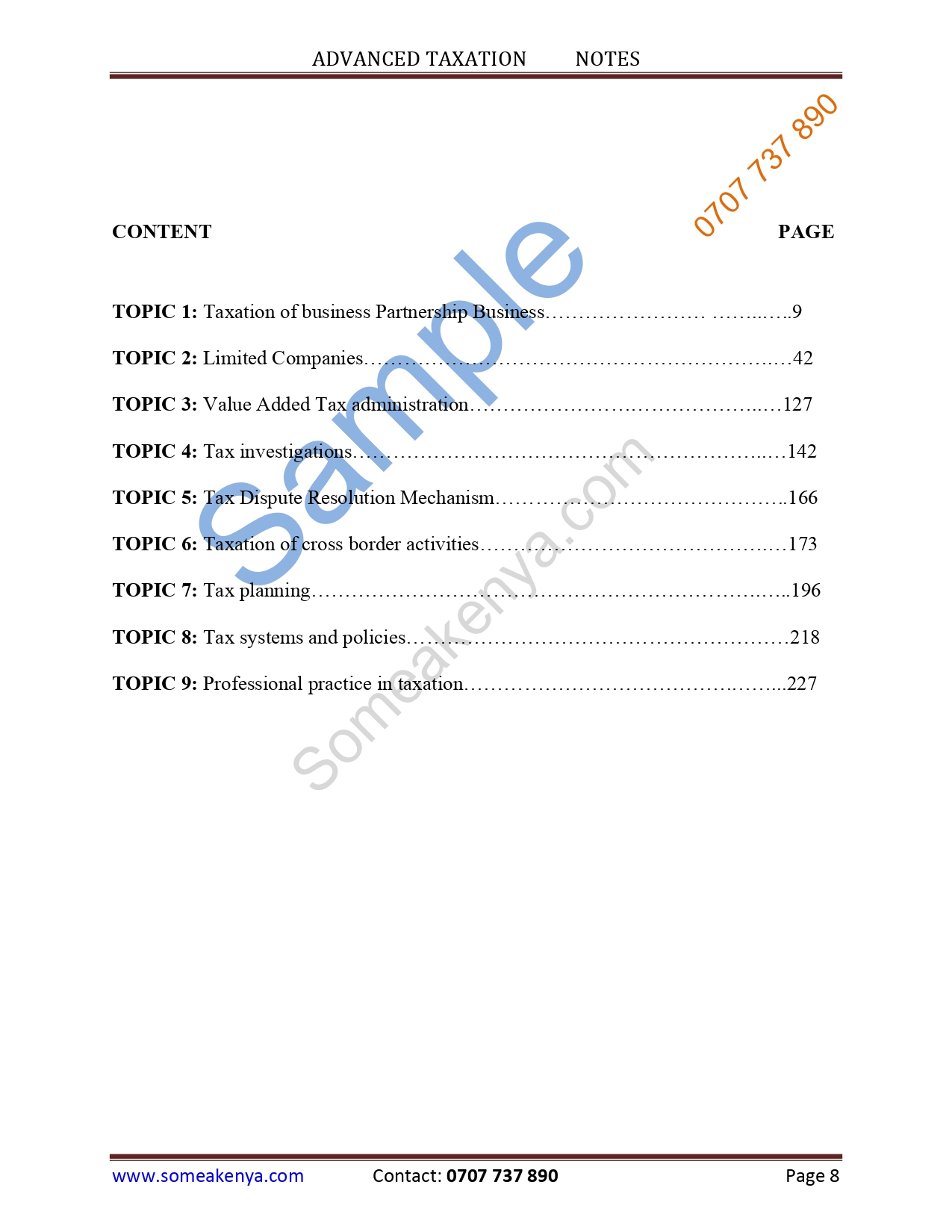
CONTENT
- Taxation of business income and specialized business activitie
- Partnership business
- Admission of a new partner and retiring partners during the year
- Conversion of partnerships into liability companies
- Incomplete records pertaining to partnership businesses
- Case law on taxation of partnership businesses
- Limited companies
- Taxation of companies, including holding company, subsidiaries, branches and related parties
- Incomplete records pertaining to limited companies
- Minimum tax
- Shortfall tax computation
- Taxation of dividends
- Case law on taxation of limited companies
- Rental income, including residential rent income, Commercial rent income and Real estate investment trusts (REITS)
- Charitable institutions
- Leasing entities, including hire purchase lease agreements
- Co-operative societies, Saccos
- Trade associations, amateur sporting association and clubs
- Trust bodies, settlements and estates under administration
- Financial institutions: Banks, insurance companies
- Sea and air transport undertakings
- Collective investment schemes
- Professional, training, management, agency, and consultancy fees
- Property developers and contractors
- Taxation of extractive industries
- Capital gain tax
- Digital service tax
- Application of relevant case law
- Value added tax administration
- Obligations of a taxable person and offences relating to VAT
- Value added tax computation
- Restriction of input tax claimable
- Imported services and VAT withholding agents
- VAT refunds and bad debt relief computation
- VAT Accountant certificate
- Value added tax automated assessments
- I tax significance and application in value added tax administration
- Application of relevant case law
- Tax investigations
- Tax fraud
- Civil and criminal tax investigation
- Events which may trigger an investigation
- Back duty and in-depth examination
- Customs and excise investigations
- Negotiation for settlement: Tax amnesty, Tax Penalties and Enforcement for outstanding taxes
- Types of tax audit and their significance
- Application of relevant case law
- Tax dispute resolution mechanism
- Tax disputes
- Stages of tax dispute resolution process
- Tax dispute resolution process cycle
- Legal framework and objectives of Alternative Dispute Resolution
- Types of tax disputes eligible for Alternative Dispute Resolution
- Benefits of Alternative Dispute Resolution
- Parties to Alternative Dispute Resolution and their roles
- Issues exempted from Alternative Dispute Resolution
- Alternative Dispute Resolution agreement terms and timelines
- Termination of alternative dispute resolution
- Taxation of cross border activities
- Distinction between trading in and trading with a country
- Double taxation agreements; theory, design and application
- Regional perspective with reference to the East African Community (EAC) and the Common Market for Eastern and Southern Africa (COMESA)
- Most favored nation status
- Nature, characteristics and significance of One Stop Border Posts (OSBPs)
- Generalized system of preference and AGOA
- Tax havens and treaty shopping
- Tax information exchange agreements (TIEAS)
- Transfer pricing: oecd guidelines
- Application of relevant case law
- Tax planning
- Tax planning for individuals: By way of Tax exempt activities, transactions that are allowable expenses and transactions attracting tax setoffs
- Tax planning for body corporates
- Identifying opportunities to alleviate, mitigate or defer the impact of direct or
- indirect taxation
- Evaluating remuneration packages
- Tax avoidance and anti-tax avoidance provisions in the tax Act, short-fall distributions of dividends
- Sectoral tax incentives
- Disposal of business operations and restructuring of activities
- Tax risk management
- Tax systems and policies
- Types of tax systems
- Role of taxation in economic development; tax base expansion, efficiency in tax systems
- Design of a tax policy
- Criteria for evaluation of a tax system
- Tax reforms and modernisation of tax systems under various Acts
- KRA structure – Large Tax Payer and Medium Tax Payer organisations
- Professional practice in taxation
- Forms of tax practice and matters relating thereto
- Matters relating to new clients
- Handling of client work
- Disclosures in tax returns, computations and correspondence with the Revenue Authority
- Moral and ethical issues in taxation
- Tax agents, appointment, obligations, professional liability
- Cancellation of tax agents license
- Role of tax agents in appeals procedure
- Tax health check
TOPIC 1
TAXATION OF BUSINESS INCOME AND SPECIALIZED ACTIVITIES
Introduction
Business income is among the specified sources of income which is taxable under sec 3(2) of the income tax. A business can be operated as a corporation, sole proprietorship or as partnership.
Factors to consider in evaluating whether the business is in the nature of trade
• Profit motive-this must be underlying objective rather than incidental.
• The nature of the asset acquired and the quantities involved.
• Method of financing.
• Method used in generating sales eg advertising.
• Mode of asset acquisition.
Taxable business income
1. Gains arising from selling and buying.
2. An amount of insurance compensation for the loss or damage of stock (for non-current asset is not taxable).
3. Bad debt recovered which were previously considered as allowable when they were written off.
4. Realized foreign gains.
5. Balancing charge and trading receipt.
Non-taxable incomes
1. Income from foreign investment.
2. Reduction in general provision for doubtful debt.
3. Additional capital introduced.
4. Capital gains eg sale of an asset at a gain.
5. Unrealized profit.
6. Dividends where the entity have atleast 12.5% equity ownership.
7. Inheritance on an individual basis.
8. Interest from government infrastructural bond with maturity period of more than 2 years.
9. Interest from post bank.
10. Insurance compensation for non-current assets
Allowable expenses
They are expenses which are wholly and exclusively incurred in the production of incomes. The guiding principle is subject to the provision of income tax act. They include:
1. Specific trade bad debt.
2. Capital allowances.
3. Subscription to a trade association.
4. Legal cost in connection with acquisition of lease of not more than 99 years.
5. Interest on loan for business development.
6. Marketing and advertising expenses.
7. Loss brought forward from previous years with a limit of 4 years.
8. Legal fees paid on listing securities.
9. Cost incurred for prevention of soil erosion.
10. Scientific research related to business.
Disallowable deductions
They are expenses not wholly or exclusively incurred on day to day operating income generating
1. Capital expenditure on acquisition of non-current assets.
2. Depreciation, impairment and amortizations.
3. Personal and private expenses.
4. General provision for bad debt but specific is allowable.
5. All provisions.
6. Tax related expenses.
7. Legal fees and other profession fees of capital nature in relation to borrowing, valuation of property and preparation of partnership deeds.
8. Capital repairs including cost of extension and replacement.
9. Fines and penalties.
10. Other expenses regarded as non-business such as donation
Donations are not allowable except in the following circumstance:
• Where the donation is to the charitable organization.
• Where the tax payer provides evidence of donation payment.
• Donations provided can be quantified in monetary value.
• Donor cannot claim a refund.
• The donor is not benefiting in any way in monetary terms.
Specified sources of income
• Business income
• Employment income
• Property income e.g. rent and royalties
• Investment income e.g. dividend and interest income
• Agricultural/farming income
• Income from past employment e.g. pension.
1.1 PARTNERSHIP BUSINESS
Introduction
A partnership is a relationship that subsists between two or more people carrying on business together with a view to making profits. Gains or profits from a partnership are assessed on the partners and not the partnership. The profits/losses arising from the partnership is added to the partner’s total income from another source. A partnership is usually established by an agreement known as a “partnership deed” which outlines the following: –
1. Amount of capital to be contributed by each partner
2. Salaries to be paid to partners
3. Interest to be charged on drawings by partners
4. Interest to be paid on capital contributed by partners
5. The profit-sharing ratio
In the absence of a deed it is assumed that, there is no interest paid on capital, no interest charged on drawings, no salaries payable to partners and that, profits & losses will be shared equally
Taxation of Partnerships
The income of the partnership is taxed on the partners.
The net profits/losses of a partnership must be adjusted for taxation of purposes, this includes adding back disallowable expenses if already deducted and deducting non- taxable incomes if already included. These adjustments are: –
1. Expenses to be allowed must have been expended wholly and exclusively in the production of that income.
2. Capital expenses are not allowable
3. Personal expenses are not allowable
4. Salaries to partners are not allowed
5. Interest on capital to partners is not allowable
6. Interest paid by partners on drawings is not taxable
7. Wife’s salaries are not allowable
8. Drawings are not allowable
9. Disposal of fixed assets is not taxable
Non allowable expenses for partners
1. Partner’s private expenses
2. Partners’ drawings
3. Partners’ salaries and commissions
4. Interest on partners’ capital
5. Goodwill written off
6. Non allowable expenses like any other business.
Allowable expenses for partners
1. Medical expenses or medical cover of up to Shs. 1,000,000 per annum per partner
2. Contribution to a registered home ownership saving plan of up to Shs. 96,000 per
annum
3. Contribution to a registered individual retirement scheme of up to Shs. 240,000 p.a
4. Owner occupier interest of up to sh. 300,000 p.a
After these adjustments, net amount is then distributed to the partners as per the deed
Distribution format
Distribution schedule of the profit or loss for the year ended 31 December xxxx
X(Kshs) Y(Kshs) Total (Kshs )
Interest on drawing (xx) (xx) (xx)
Salaries and wages XX XX XX
Interest on capital XX XX XX
Commission XX XX XX
Drawings XX XX XX
Share of profit XX XX XX
Total XX XX XX
Illustration
Anna and Hazel have been partners trading as AH enterprises. They prepare their accounts to 31 December every year. Due to the need to expand their business, they decided to admit Grace on 1 September 2021. Grace brought in Sh.2,000,000 as his capital plus his contribution towards goodwill. Prior to the admission of Grace, the profit and loss sharing ratio was 2:3 between Anna and Hazel respectively. However, with the admission of Grace, they revised the profit and loss sharing ratio to 2:3:1 for Anna, Hazel and Grace respectively. Their business was changed to trade under the name AHG enterprises.
The partners have presented the following profit and loss account for the year ended 31 December 2021:
Income Sh. Sh.
Gross profit 6,000,000
Foreign exchange gain 312,000
Interest on drawings: Anna 500,000
Grace 60,000
Interest on bank deposits (net) 120,600
Insurance compensation for stolen vehicle 400,000
7,392,600
Expenditure:
General expenses 3,500,000
Salaries and wages 2,400,000
Interest on capital: Anna 160,000
Hazel 140,000
Grace 30,000
Legal expenses 487,500
Loss on sale of assets 15,200
Stamp duty on lease agreements 8,160
Licenses and permits 14,400
Subscriptions to trade association 56,000
Conveyance fees 150,000
Rent and rates 240,000
Salaries to partners: Grace 180,000
Mortgage interest 240,000
Repairs on computers 60,000
Furniture purchased (cost) 84,000
Bank charges 80,000 (7,845,260)
Reported loss (452,660)
Additional information:
1. General expenses comprise: Sh.
Embezzlement by accountant 1,200,000
Staff Christmas party 800,000
Amount paid to retrenched staff 760,000
Replacement of car engine 140,000
Partition of an office 600,000
3,500,000
2. Salaries and wages include Sh.700,000 and Sh.800,000 paid to Anna and Hazel respectively during the year.
3. Interest on capital was provided at 45% of the capital contributions.
4. Legal expenses include: Sh.
Parking fines paid to county government 15,200
Legal fees for breach of contract 200,000
Drafting of tender documents 18,000
Drafting of lease agreements (99 years) 9,000
Defending a partner in a tax case 12,000
Legal cost of debt collection 233,300
5. Mortgage interest relates to a partner’s residential house.
6. Assume that the income accrued evenly throughout the year.
7. Ignore capital allowances.
Required:
The adjusted partnership profit or loss for the year ended 31 December 2021
Solution
AH & AHG Enterprises
Adjusted partnership profit or loss for the year ended 31 December 2021
Incomes Kshs Kshs
Reported loss (452,660)
Add Back: Disallowable expenses
General expenses: Embezzlement by accountant 1,200,000
Staff Christmas party 800,000
Partition of an office 600,000
Salaries to partners: Anna 700,000
Hazel 800,000
Grace 180,000
Interest on capital: Anna 160,000
Hazel 140,000
Grace 30,000
Legal expenses: Parking fines to county government 15,200
Legal fees for breach of contract 200,000
Defending a partner in a tax case 12,000
Loss on sale of assets 15,200
Mortgage interest (partner’s residential house) 240,000
Furniture purchased (cost) 84,000 5,176,400
Deduct: Allowable expenses/non-taxable incomes
Interest on drawings: Anna 500,000
Grace 60,000
Interest on bank deposits (net) 120,600
Insurance compensation for stolen vehicle 400,000 (1,080,600)
Taxable income/(loss) 3,643,140
Allocation of the profits or losses above to the partners
AH & AH Enterprises
Allocation of the profits or losses for the year ended 31 December 2021
Anna
(Kshs) Hazel
(Kshs) Grace
(Kshs) Total
(Kshs)
Salaries to partners 700,000 800,000 180,000 1,680,000
Interest on capital 160,000 140,000 30,000 330,000
Defending a partner in a tax case* 12,000 – – 12,000
Mortgage interest (partner’s
residential house) * – 240,000 – 240,000
Share of profit:
1st 8 m (2:3) 368,304 552,456 – 920,760
2nd 4 m (2:3:1) 153,460 230,190 76,730 460,380
Total share 1,393,764 1,962,646 286,730 3,643,140
*These incomes will be taxed on the individual partners using the graduated scale
ADMISSION OF NEW PARTNER AND RETIRING PARTNERS DURING THE YEAR
Taxation of Partners
The net profits/losses of a partnership must be adjusted for taxation purposes; this includes adding back disallowable expenses if already deducted and deducting non-taxable incomes if already included. These adjustments are: –
• Expenses to be allowed must have been expended wholly and exclusively in the production of that income.
• Capital expenses are not allowable
• Personal expenses are not allowable
• Salaries to partners are not allowed
• Interest on capital to partners is not allowable
• Interest paid by partners on drawings is not taxable
• Wife’s salaries are not allowable
• Drawings are not allowable
• Disposal of fixed assets is not taxable
After these adjustments, the net amount is then distributed to the partners as per the deed
Illustration 1
Jack & Jill are in partnership and share profits/losses equally in the year of income 2014 when they posted a loss of Kshs.65, 000. Their accounts were as follows: –
Incomes Kshs
Interest (KCB) 40, 000
Dividends (Bidco) 50, 000
Sales 600, 000
Disposal of delivery van 20, 000
Refund of income tax 65, 000
Sales of Jill’s shamba 250, 000
Expenses
Purchases 300, 000
Salaries: – Jack 40, 000
– Jill 50, 000
Interest on capital: – Jack 20, 000
– Jill 20, 000
Commission to Jack 40, 000
Purchase of van 400, 000
Advertising 100, 000
Workers’ salaries 20, 000
Electricity 100, 000
Additional Information
1. Upon Audit of the books of Jack & Jill partnership the Revenue Authority realized that Jack and Jill disagreed on the management of the partnership and parted ways. Jack opted to retain the business and after back and forth negotiations Jill introduced his friend Ebb to Jack who was willing to join the business as a partner.
2. Jill and Ebb had agreed that Ebb continue with the partnership as if he were Jill and that all conditions that applied to Jill when he was partner will apply to Ebb.
3. On 1st September 2014 Jill formally quit the partnership and Ebb joined Jack as his new partner
4. Jill did not get any kind of settlement from the Partnership since they had agreed with Ebb on an amount to be paid to him to take his place in the partnership. However, it was agreed that Jill will be liable to all liabilities, which arose when he was member, and will enjoy all the benefits from the partnership, which accrued when he was still a member.
5. Jack and Ebb, appreciated the fact that Jill & Ebb had an agreement to switch places without any settlement from the partnership hence did not see the need to draw up separate accounts for Jill & Ebb hence they decided to close that year’s books with Jill’s name as if he were still partner.
Required
a) Adjusted partnership profit/loss at the end of the year 31st December 2014
b) Distribution of the partnership profit/loss at the end of the year 31st December 2014
Solution
Adjusted partnership profit/loss for the ended 31st December 2014
Item Kshs Kshs
Loss as per accounts (65, 000)
Add:
Salaries to Jack, Ebb & Jill 90, 000
Interest on capital to Jack, Ebb & Jill 40, 000
Commission to Jack 40, 000
Purchase of van 400, 000 570, 000
Less:
Interest (KCB) 40, 000
Dividends (Bidco) 50, 000
Disposal of delivery van 20, 000
Refund of income tax 65, 000
Sales of Jill’s Shamba 250, 000
WTD-M/V (25% 0f 400,000) 100,000 (525, 000)
Adjusted profit (20, 000)
Distribution of the partnership profit/loss for the ended 31st December 2014
Item Jack Ebb Jill Total
Salaries 40, 000 16,667 33, 333 90, 000
Interest on capital 20, 000 6,667 13, 333 40, 000
Commission 40, 000 Nil Nil 40, 000
Balance (shared in PSR) (95, 000) (31, 667) (63, 333) (190, 000)
Taxable Income 5, 000 (8, 333) (16, 667) (20, 000)
Illustration 2
December 2021 Question four B
Lipa and Mali are in partnership trading as Lima Enterprises where they share profits and losses in the ratio of 2:1 respectively.
On 1 April 2020, Sasa was admitted with one-third of the profit without altering the existing profit-sharing ratio of Lipa and Mali.
The following income statement for the year ended 31 December 2020 was provided by the partnership:
Sh. Sh.
Gross profit 2,960,000
Less:
Salaries and wages:
Staff 360,000
Partners 428,000
Interest on capital 150,000
Current Account: Lipa
Mali 42,000
48,000
Insurance 24,500
Motor expenses 32,500
Electricity bills 58,000
Legal expenses 142,400
Audit and accountancy fees 47,500
Depreciation 128,400
Purchase of furniture 240,000
Provision for bad debts 18,400
Telephone and postage 14,200
General expenses 354,000 2,087,900
Net profit 872,100
Additional information:
1. Insurance represents Mr. Mali’s life insurance policy for his family.
2. Interest on capital was prorated and shared according to the profit and loss sharing ratios.
3. Legal expenses included: expenses related to drawing of new partnership deed of Sh.28,000 on admission of Mr. Sasa, conveyance fees of Sh.14,900 and Sh.36,000 for negotiating a loan facility.
4. General expenses included cost of computers of Sh.90,000 and computer software of Sh.45,000.
5. The firm imported a motor car for use in the partnership business for Sh.800,000. This excluded import duty of 25% and value added tax at 16%.
Note: Assume that income and expenses accrued evenly during the year.
Required:
(i) (Prepare a statement of adjusted taxable profit or loss for the year ended 31 December 2020. (10 marks)
(ii) Total taxable income for each partner. (4 marks)
ANSWER
Lima Enterprise
Computation of Taxable Profit or Loss For The Year Ended 31 Dec 2020
Sh
Reporting profit 872,100
Add back disallowable
General expenses – cost of computer 90,000
– cost of software 45,000
Provision for bad debt 18400
Purchase of furniture 240,000
Depreciation 128,400
Legal fees- new partner deed 28,000
Conveyance fee 14,900
Insurance 24,500
Interest on capital 150,000
Current account –lipa 42,000
-mali 4,8000
Salaries – partners 428,000
Less: allowable expenses
Investment allowance (24,000)
Furniture 10%×240,000 (22,500)
Computer 25%×45,000 (11,250)
Motor car 25% (800,000×125%×116%) (290,000)
Taxable profit 1,781,550
ii) Partners allocation schedule 2:1:1
Lipa Mali Sasa total
Salaries – 3 Months 107 71,333 35,667 – 107,000
9 months 321 160,500 80,250 80,250 321,000
Invest on capital – 3 month 25,000 12,500 – 37,500
9 Month 56,250 28,125 28,125 112,500
Profit share – 3 month 200,592 100,295 – 300,887
-9 month 451,307 225,653 225,653 902,613
Taxable income 964,982 482,490 334,028 1,781,550
CONVERSION OF PARTNERSHIPS INTO COMPANIES
A Limited Liability Company is referred to as a “company” by The Income Tax Act (Cap. 470) and it defines it as, “a company incorporated or registered under any Law in force in Kenya or elsewhere” While, A Partnership is defined by The Partnership Act (Cap. 29) Laws of Kenya as, “the relation, which subsists between persons carrying on a business in common with a view of profit.”
Conversion is where one has been doing business formed as a partnership and now has decided that it would be better off operating the business as a limited liability company (LLC). One would therefore wonder: How can a partnership business be converted into an LLC?
The main reason for a partnership converting to an LLC is to enable the partners to avoid personal liability for the debts of the business. In a partnership, each partner has joint and several liabilities for the debts of the business. However, a member in a limited liability company is not responsible for the debts of the company. A member’s liability is generally limited to his contribution to the LLC.
Taxation of partnership to a limited liability companies
Income tax is payable at the corporation rate by companies and unincorporated organizations and associations (excluding partnerships, sole proprietorships, and interest or dividend paid by a designated co-operative society) that have taxable income as defined by the Income Tax Act (Cap. 470) at a rate of 30% resident and 37.5% for non-resident Companies.
The income of a partnership or a sole proprietorship on the other hand is not taxable on the business entity but is taxed on the individual partner or the proprietor. Each partner of a partnership and a sole proprietor is therefore required to declare his business and professional income as part of his personal income and pay tax as per his respective personal tax bracket.
If a business is converted mid-year therefore from a partnership into a liability company, the company will therefore have two accounts. One as a partnership and the other as a limited liability company and taxes will be paid as outlined in the foregoing paragraph.
Note:
• For conversion, we start with gross profit unless otherwise stated
• Some expenses are allowable to company but disallowable to partnership business e.g. salaries to partners, rent expense when the building is owned by the partners
Illustration 1
December 2012 Question Three B
Samuel and Velom have been operating Savel Enterprises, a partnership business from January 2010 sharing profits and losses equally.
The following was the firm’s income statement for the year ended 31 December 2011:
Income statement for Savel Entreprises for the year ended 31 December 2011.
